Yang Jinwen
The Dark ForestYang Jinwen, usually called Lao Yang by his neighbor Zhang Yuanchao, is a retired middle school teacher in Beijing whose apparently ordinary life becomes a small but durable measure of humanity’s changing relationship to history. He urges Zhang to learn, pay attention, and recognize that world affairs are not remote abstractions: they reach into pensions, homes, fears, friendships, and the fate of generations. His life begins in the setting of everyday retirement and ends with his remains launched from the Solar System at the third cosmic velocity, turning a neighborhood voice into an emblem of human curiosity and participation in a history too large for any one lifetime.
Identity and Background
Yang Jinwen is identified as a retired middle school teacher and one of three longtime Beijing neighbors, alongside Zhang Yuanchao and Miao Fuquan. Retirement does not make him indifferent or withdrawn. On the contrary, he treats continued learning as an obligation of living fully. He repeatedly tells Zhang that the later years should be used to acquire new knowledge, offering the Internet as an example and teasing him that even babies can learn to use it.
His outlook sharply contrasts with Zhang’s deliberate provincialism. Zhang takes pride in knowing little about domestic or international affairs, believing that public matters have nothing to do with the steady life of an ordinary person. Yang Jinwen watches the evening news, follows national economic policy and international nuclear proliferation, and argues passionately with online commentators. The contrast is not merely comic. Zhang’s detachment offers emotional protection from distant crises, while Yang’s attention exposes him to the burden of understanding them.
Friendship with Zhang Yuanchao
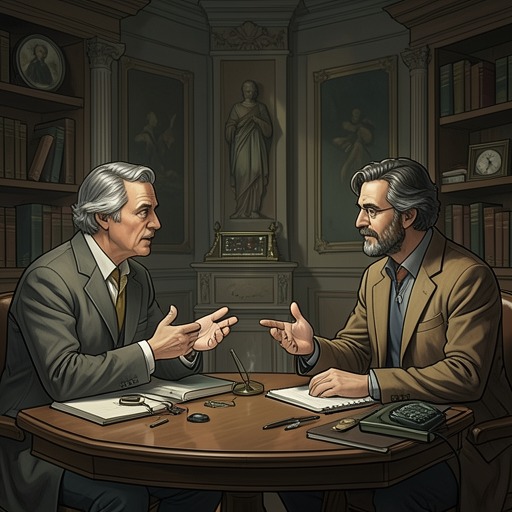
Yang Jinwen’s most sustained relationship is with Zhang Yuanchao. He acts as a neighbor, teacher, intellectual companion, and sometimes an exasperated corrective to Zhang’s habits. He tells Zhang that ignoring the outside world may remove headaches, but it also produces an incomplete life. In Yang’s view, major national and international issues, government policies, and United Nations resolutions affect ordinary people through direct and indirect channels. He specifically connects international conflict to the practical question of Zhang’s pension, translating geopolitics into the language of household security.
At first Zhang laughs at what he sees as Yang’s excessive interest in affairs of state. The developing Trisolar Crisis reverses that judgment. Zhang comes to understand that Yang had been right: the world’s largest decisions can enter an ordinary apartment, a bank queue, a retirement calculation, or a conversation between neighbors. When Zhang rings Yang’s doorbell, he approaches him with the urgency of a man who has found a fellow traveler in the desert. Their friendship therefore becomes a human-scale version of the novel’s larger argument that no private existence remains isolated from planetary history.
The Three Neighbors in a Changing World
Yang’s companionship with Zhang and Miao Fuquan preserves a recognizable rhythm of ordinary life even as civilization moves toward unprecedented danger. When Miao returns from a trip, he invites the two neighbors to drink at his home, where a Sichuan woman has prepared a sumptuous feast. During the meal, Zhang asks about Miao’s visit to the Construction Bank and learns that people have been packed three deep at bank counters, with some trampled to death. Financial panic and mass death arrive in the conversation not through a military briefing but through neighborhood drinking and questions about withdrawn money.
A breaking-news fanfare then interrupts the meal. The three old men remember that such broadcasts were common before the 1980s but had disappeared during the long period of prosperity and tranquility that followed. The renewed frequency of emergency announcements marks the return of history as an audible presence in domestic life. A special session of the General Assembly is announced to address Escapism, a doctrine that argues humanity should build starships for a minority rather than rely on a defense of Earth and the Solar System over the four and a half centuries before the Trisolaran arrival. Yang’s attentive civic habit gives him a place to receive and interpret this transformation, while the shared meal keeps the scale of the crisis grounded in familiar human relationships.
Thought, Secrecy, and Historical Awareness
Yang Jinwen’s importance is illuminated by the novel’s contrast between human and Trisolaran communication. Trisolarans do not possess organs of communication in the human sense; their brains display thoughts to the outside world through electromagnetic waves, including visible light. Their directness makes deception difficult, whereas human beings retain a private inner world that sophons cannot read so long as thoughts are not communicated outwardly.
This distinction supplies the basis of the Wallfacer Project. Because sophons make Earth effectively transparent—able to observe meetings, files, computers, plans, and deployments—humanity’s remaining strategic advantage lies in thoughts that have not been expressed. Yang’s behavior belongs to the opposite, civic side of this tension. He insists on confronting public information rather than pretending it is irrelevant. His conversations do not constitute a secret plan, but they demonstrate the value of a mind that remains engaged with the world instead of retreating into a supposedly safe private routine.
Death and the Final Journey
Yang Jinwen outlives both of his closest neighbors. Miao Fuquan dies first at seventy-five and arranges for his son to bury him two hundred meters down an abandoned mine, with instructions that the tombstone be removed before the Doomsday Battle and restored if humanity wins. Zhang Yuanchao later dies of illness at eighty and receives an ordinary cremation, his ashes placed in a rectangular slot in a public cemetery.
Yang lives until ninety-two. Unlike the conventional burial and cremation of his friends, his remains are placed in an alloy vessel that leaves the Solar System at the third cosmic velocity. The voyage consumes all his savings. This final act is both concrete and symbolic: the teacher who demanded attention to the outside world ultimately sends himself beyond the most familiar human boundary. His choice does not defeat the Trisolaran threat or preserve his individual consciousness, but it refuses to let death end his relation to the universe.
Narrative Role and Significance
Yang Jinwen is a modest figure whose significance grows through contrast and retrospect. He is neither a military commander nor a technological visionary, yet his insistence that public events matter to private lives proves more accurate than Zhang’s comfortable indifference. His arguments anticipate the way financial panic, Escapism, planetary defense, and the Trisolaran Crisis will reshape ordinary existence.
The three neighbors also embody different responses to historical scale. Miao Fuquan responds through a strange, conditional burial linked to victory; Zhang remains within ordinary funerary practice; Yang spends everything to send his remains into cosmic space. Their endings form a progression from local memory to ordinary disappearance to deliberate cosmic extension. Yang’s trajectory gives the novel’s immense chronology an intimate anchor: the future is not inhabited only by fleets, councils, and scientists, but also by an old teacher who keeps watching, keeps arguing, and finally chooses to travel farther than any neighborhood conversation can reach.